A new way of engineering materials is to introduce components into materials that encode properties that are enabled in response to external factors or changing environmental conditions. This idea goes beyond the conventional thinking that materials have static properties that are realized once the material is manufactured. In contrast, “smart” materials design is aimed at finding ways to incorporate a built-in responsiveness that can be triggered with a broad range of stimulus, such as changes in pressure, temperature, light, pH, etc.
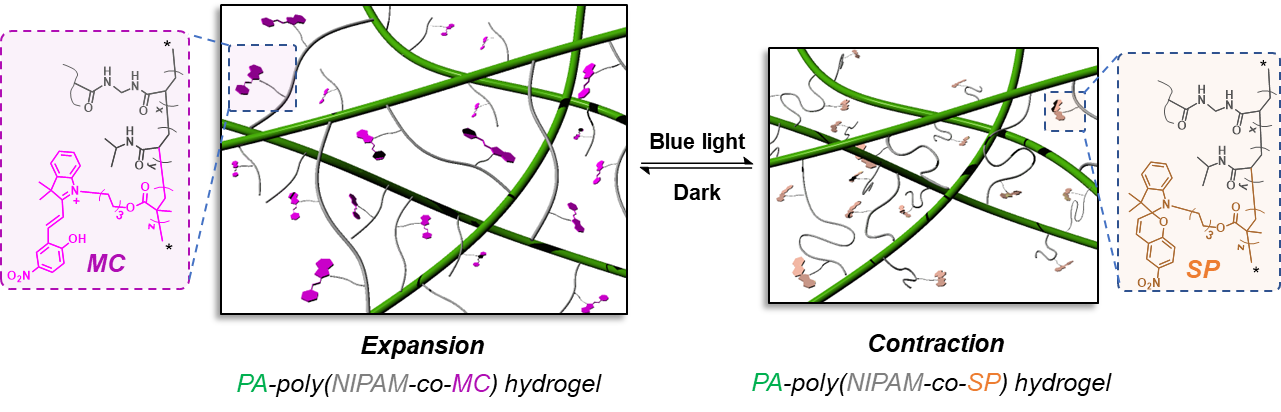
Nanofibers synthesized from self-assembling peptide amphiphiles (PAs) were combined with light-responsive spiropyran hydrogels to develop a supramolecular-covalent hybrid material that can transform its shape, rotate and crawl in response to changes in light conditions. Our model and simulations showed that the supramolecular structure act as a channel to drain water out of the hydrogel during light-activated actuation. Such draining in conjunction with the noncovalent distortions suggested by the simulations could enhance the speed and/or reversibility of photo-actuation.
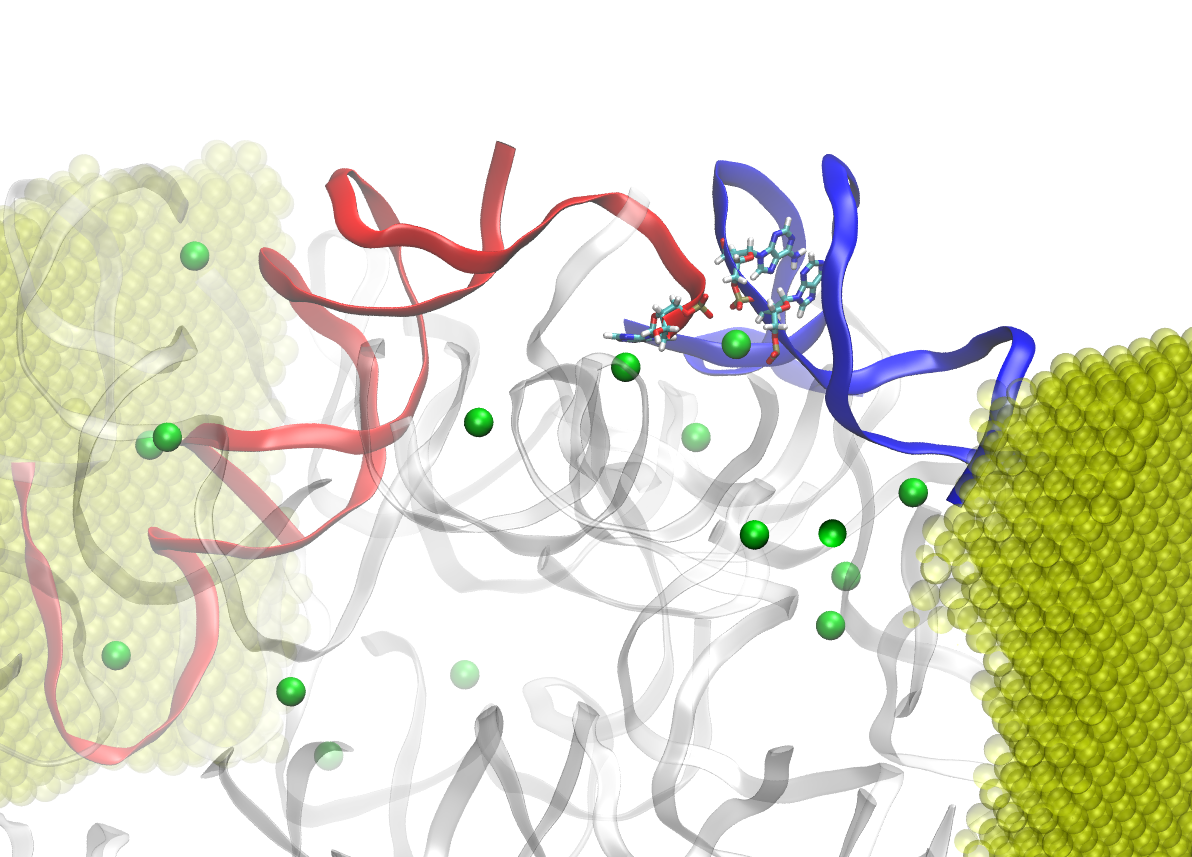
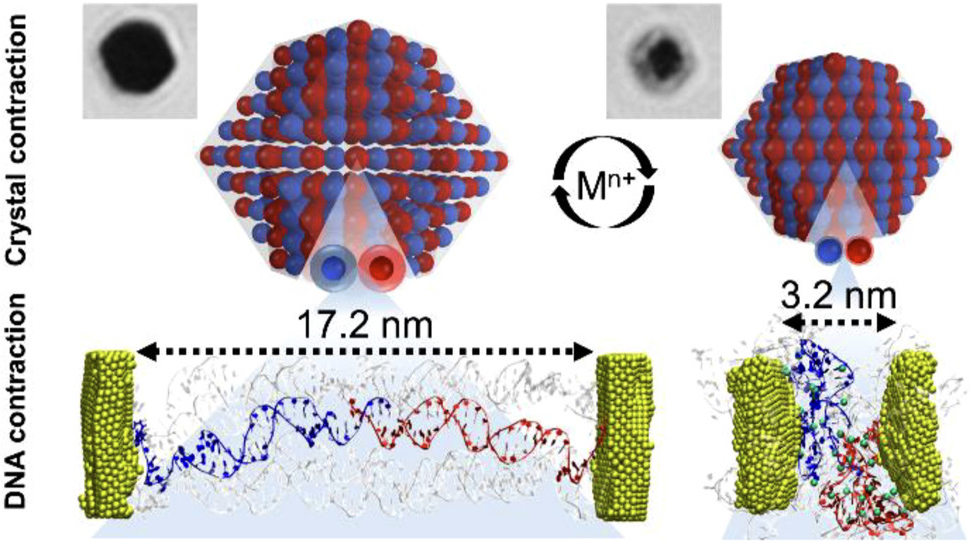
Furthermore, we also developed DNA-mediated colloidal superlattices that respond to ionic strength as an external stimulus to create highly tunable superlattice properties. The strength of interaction between ions and DNA is varied by addition of different salts to create reversible contractions of the “DNA bond” that links gold nanoparticles in the superlattice, allowing for dynamical control over the optical, magnetic and mechanical properties for these colloidal crystals. Our simulations gave us insight on the mechaniscm of reversible actuation and how different multivalent cations can interact with DNA.
See simulation here.
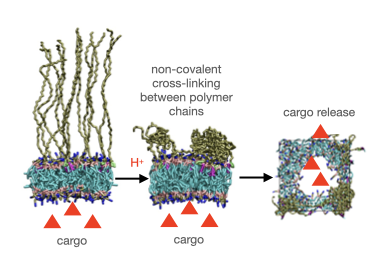
In a different project, we designed ultra-small polymer-grafted nanobins (usPGNs) for drug delivery applications that respond to change in pH with the use of the poly(acrylic acid) polymers grafted onto the liposome membrane. The grafted polymer design not only allows for the pH response but also enhances the stability of the vesicles with small hydrodynamic diameters (D < 50 nm), which is preferable for drug delivery to cells. An increase in pH as a result of crossing cell membranes triggers the polymer to collapse onto the vesicle and release its cargo through the holes that form in the membrane.
References
C. Li, Q. Xiong, T. D. Clemons, H. Sai, Y. Yang, M. H. Sangji, A. Iscen, L. C. Palmer, George C. Schatz, S. I. Stupp, Role of Supramolecular Polymers in Photo-actuation of Spiropyran Hydrogels, Chemical Science 14, 6095-6104 (2023), DOI: 10.1039/D3SC00401E
C. Li, A. Iscen, H. Sai, K. Sato, N. A. Sather, S. M. Chin, Z. Alvarez, L. C. Palmer, G. C. Schatz and S. I. Stupp, Supramolecular–covalent hybrid polymers for light-activated mechanical actuation, Nat. Mater. 19, 900–909 (2020). https://doi.org/10.1038/s41563-020-0707-7
C. Li, A. Iscen, L. C. Palmer, G. C. Schatz, and S. I. Stupp, Light-Driven Expansion of Spiropyran Hydrogels, J. Am. Chem. Soc. 142 (18), 8447-8453 (2020). DOI: 10.1021/jacs.0c02201
D. Samanta, A. Iscen, C. R. Laramy, S. B. Ebrahimi, K. E. Bujold, G. C. Schatz, C. A. Mirkin, Multivalent Cation Induced Reversible Actuation of Colloidal Superlattices, J. Am. Chem. Soc. 141 (51), 19973-19977 (2019). DOI: 10.1021/jacs.9b09900
B. J. Hong, A. Iscen, A. J. Chipre, M. M. Li, One-Sun Lee, J. N. Leonard, G. C. Schatz, S. B. T. Nguyen, Highly stable, ultrasmall polymer-grafted nanobins (usPGNSs) with stimuli-responsive capability, J. Phys. Chem. Lett. 9, 1133-1139 (2018). DOI: 10.1021/acs.jpclett.7b03312